- Key idea: The plants and animal life need clean air to help them grow – e.g. Observing reduced variety and damage to leaves in different locations (UC1.3).
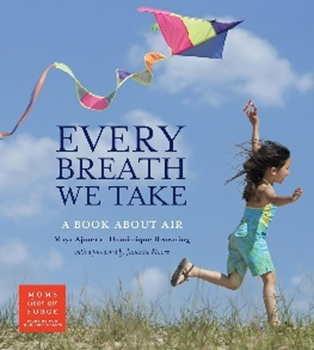
Title: Every Breath We Take
Author: Maya Ajmera
Illustrator: Dominique Browning
Publisher: Harlesbridge Pubs
Publication Date: 2016
ISBN: 978-1580896160
This book underscores the importance of clean air to all life on earth. It also reminds us that sometimes the air can be dirty, and it can be cleaned up.


Emergent learning:
There are two key ideas for us here: First, all the plants and animals of the world need clean air to help them grow. Second, human activity affects air quality.
Children learn about their natural environment, and they learn about the properties of various materials through their freedom to play, and this is why most preschools provide a sand pit, soil for planting, and natural materials and collections of blocks, beads and fabrics. Preschools also often have a water play area so that children begin to learn about the behaviour of fluids, about capacity and volume.
We can also encourage “Air Play”: Children probably wouldn’t learn very much about air at all, if we didn’t draw their attention to it. It’s invisible. But it’s the stuff inside bubbles, and it can hold a kite in the air – and if we go for a run holding an umbrella or a cardboard ‘sail’ in front of us, we can feel how it holds us back and begin to appreciate the streamlined shapes of cars, and boats and ‘airplanes’.
Activity recommendation:
Young children can also learn to be concerned about air pollution when we draw their attention to chimneys, and if we take them out wiping soot off roadside street signs, the source can usually be observed quite clearly in vehicle exhausts. A survey of nearby streets simply involved using standard ‘wipes’ and a display of findings.
Other Book recommendations:
 Involve Me