Key idea: Human activity affects air quality and water quality – .g. Identifying vehicle soot on street signs, Involving the children in litter picking activities. (UC1.5)
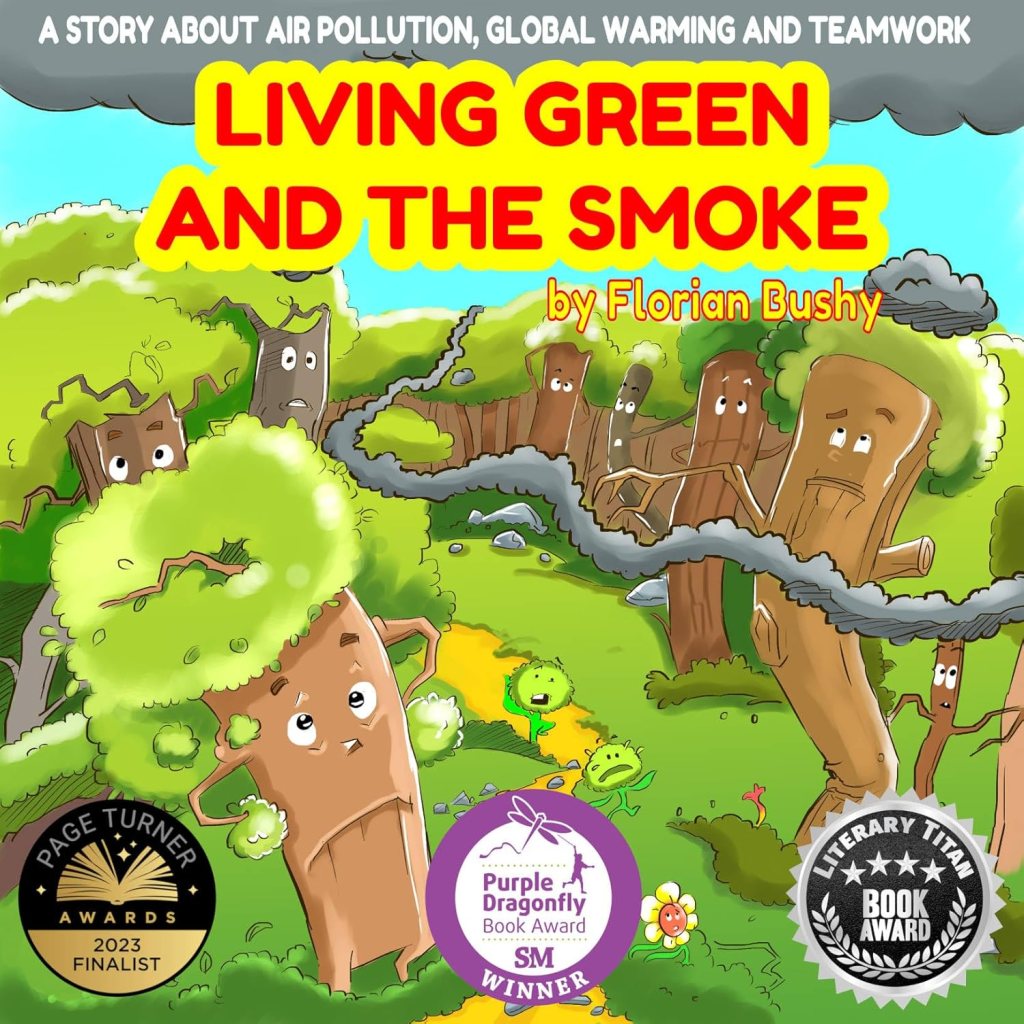
Title: Living Green and the Smoke Author: Florian Bushy Illustrator: Florian Bushy Publisher: Independently published Publication Date: 2022 ISBN: 979-8408393039
A story about air pollution, global warming and teamwork.
Emergent learning:
It is important that we don’t just talk about this topic we do something about it. We clean things up together, we take pride in doing it and celebrate our own, and the achievements of others in this area. We must show the children that we care. Children all over the world will be engaged in sustainable projects on Earth Day. Below you will find a link to the Earth day website and if you are planning a project you can post details on the site so that children around the world can see what you are doing. This is important, if children learn about the efforts being made by children in other countries it will help foster co-operation and undermine prejudices. It requires international co-operation and collaboration to solve the problems of climate change. In cities in many countries there are air quality monitoring systems to warn the public of the dangers to health, and in teaching our children about these common problems and experiences and our efforts to solve them, we contribute towards the development of a more collaborative world in the future. Our treatment of problems that are concerned with our Social and Cultural Environment require a similar approach to the natural environment.
Activity recommendation:
Wiping a roadside street sign with a white cloth will identify the effects of vehicle exhausts which can also be observed from tailpipes, and engaging thechildren in filtering dirty water in tissues will show the particulates. Activities associated with hygiene and hand washing are relevant. If you put celery in coloured water this can demonstrate how pollution affects plants. The colour traveling up the stalk provides an illustration for the effect of a pollutant. Children can be engaged in street, countryside and beach Litter Picking activities. Where these involve the wider community the children learn more about solidarity and civic responsibility as well. Visits to public waste and recycling centres may be instructive
Other book recommendations:
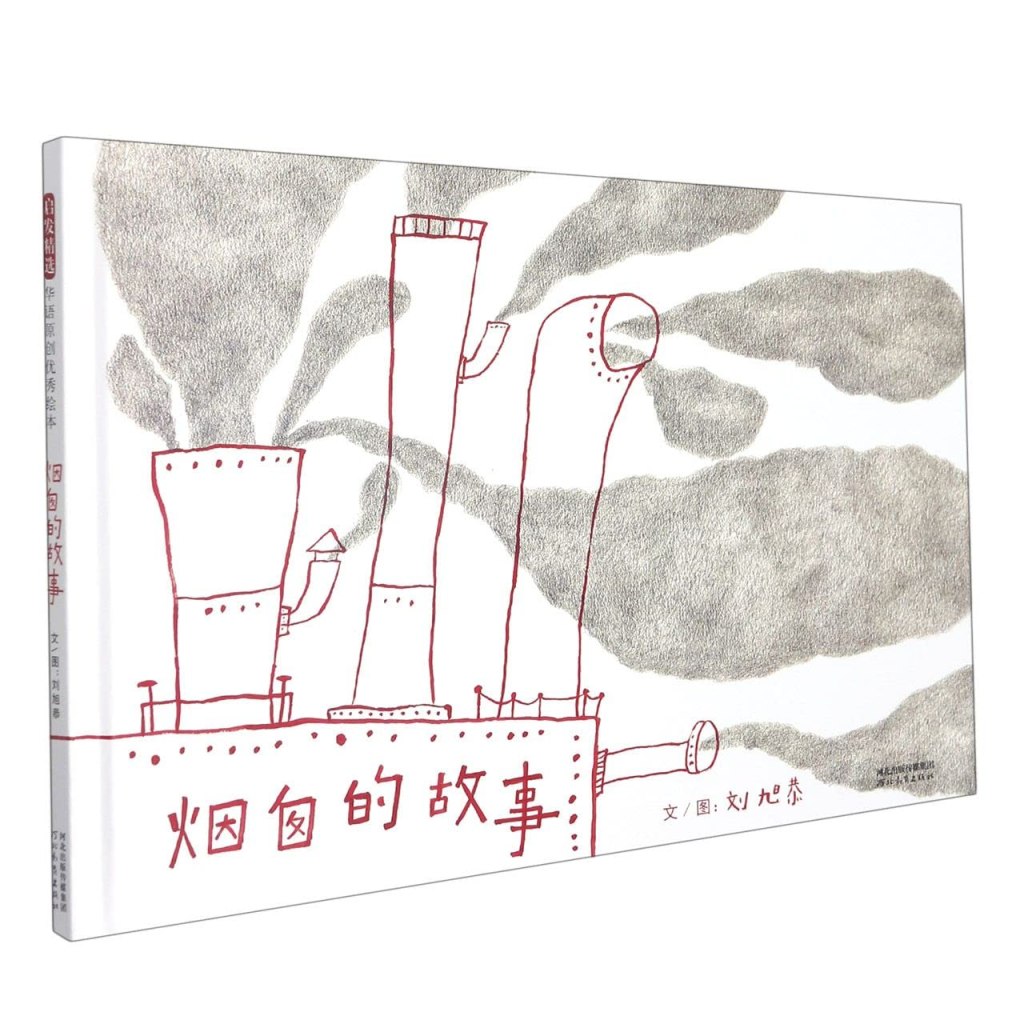
Title: A Story of Chimneys Author: Liu Xugong Illustrator: Publisher: Hebei Education Press Publication Date: 2021 ISBN: 978-7554567395
A Chinese Text about the pollution created by power plant and factories.
Key idea: There are different forms of transportation – e.g. Producing a tally of the forms of transport used by children and staff, identifying more sustainable alternatives (UC6.6)
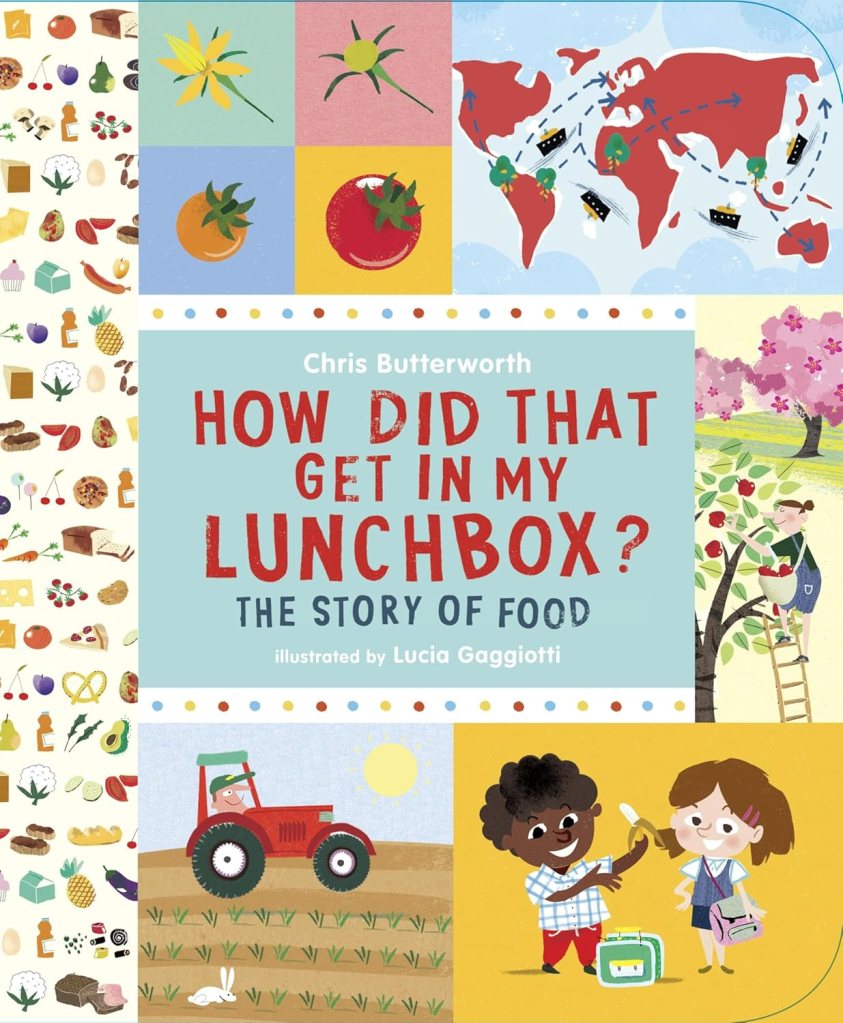
Title: How did that get into my lunchbox? Author: Chris Butterworth Illustrator: Lucia Gaggiotti Publisher: Candlewick Press Publication Date: 2011 ISBN: 978-0763650056
An engaging look at the steps involved in producing some common foods. Also some healthy tips and an introduction to basic food groups.
Emergent learning:
Being a sustainable citizen is all about making sustainable choices. It’s about being a sustainable consumer, being economic and conserving nature and its resources. As a child you can’t learn to make good choices if your parents and other adults around you make all your choices for you.
In many homes and preschools children are encouraged to choose their own play toys and activities and ‘snacks times’ also provide a great opportunity for them to learn to be more independent, how to make decisions, about making sustainable choices, about sharing, and about respecting the needs and choices made by others.
Snack time also provides a context for the development of crucial fine motor skills like pouring and cutting, for the child to improve language and math skills by discussing food, portions and sharing, and also to learn about their own appetites and food choices.
Activity recommendation:
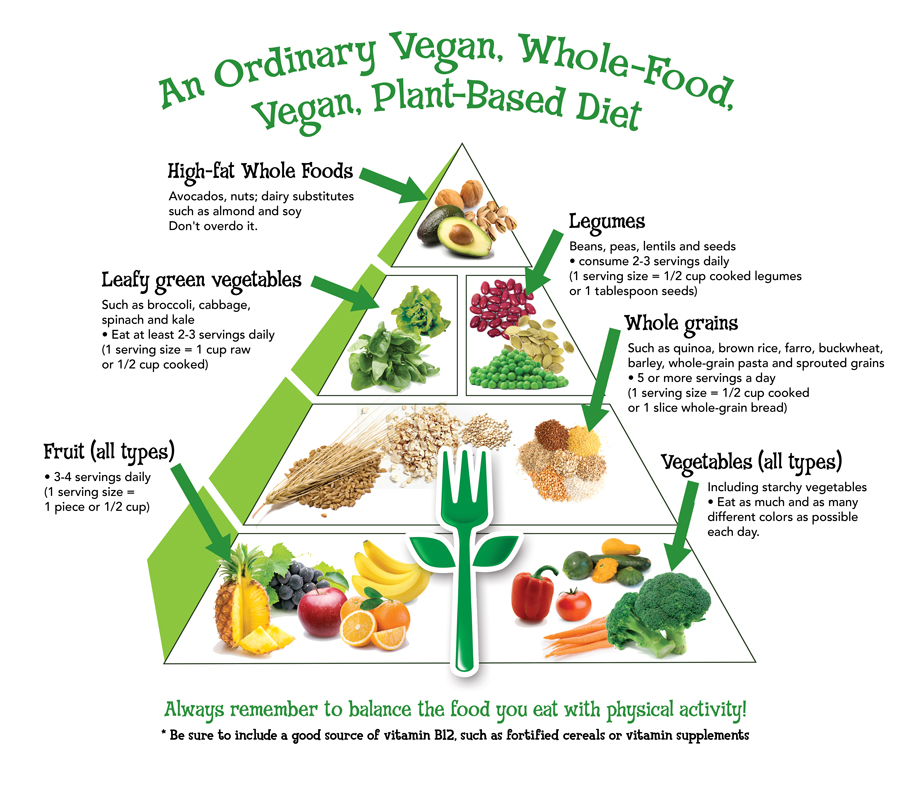
Every mealtime can be a rich educational experience, and the more we can involve the children in making choices and in the preparation of food the better. Touching, smelling and tasting the food is an opportunity to talk, to socialise, and to develop their senses, mathematical understandings and emergent science. We can also organise trips to local food producers and shops so the children can see where their food comes from. Advice to support planning of menus in the UK is available from the Soil Association and from the Food for Life programme although they are heavily meat and dairy based. More sustainable, and healthier dietary options are vegetable and fruit based. There is much to be learnt from considering studying food pyramids, including the Whole Food Vegan Food Pyramid:
Key idea: There are different forms of transportation – e.g. Producing a tally of the forms of transport used by children and staff, identifying more sustainable alternatives (UC6.5)
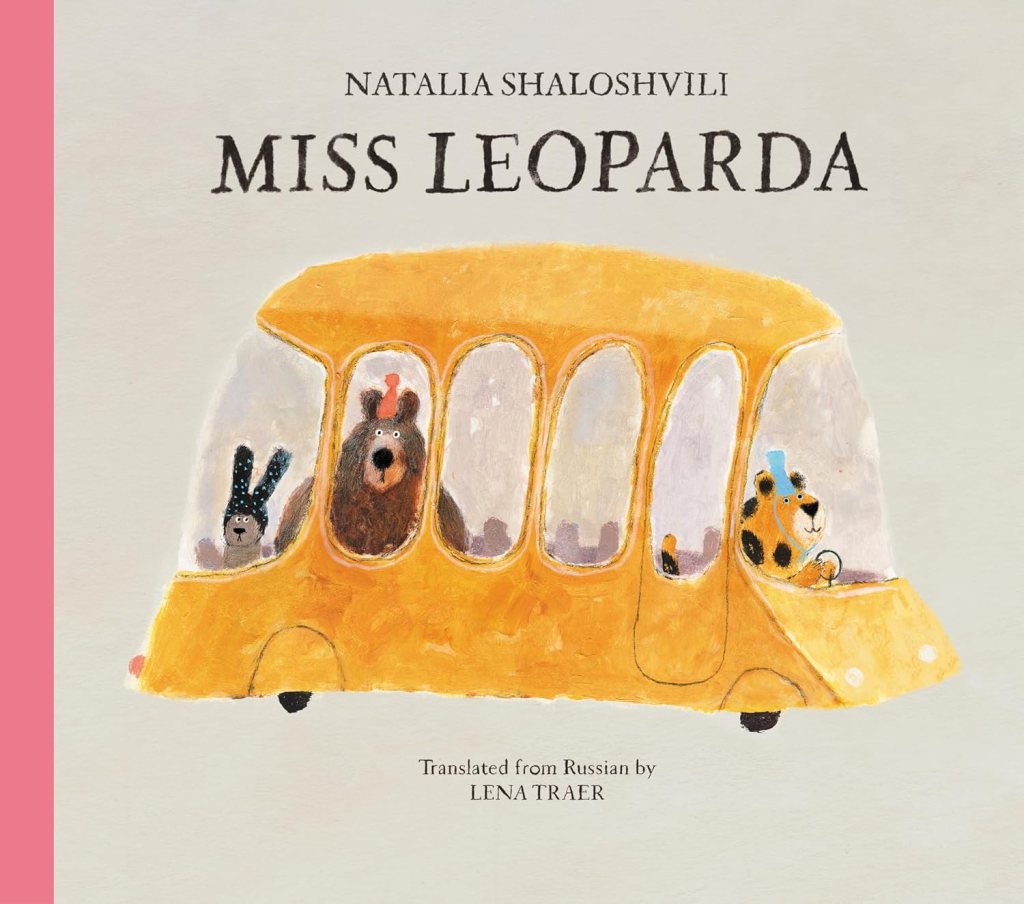
Title: Miss Leoparda Author: Natalia Shaloshvili Translator: Lena Traer Publisher: Enchanted Lion Books Publication Date: 2024 ISBN: 978-1592704125
“An ecologically minded book about a bus-loving, tree-loving, leopard”.
Emergent learning:
It might be assumed that sustainable transportation is too difficult a concept for young children to understand. But they can learn about different forms of transportation, and they can learn about sharing, and about waste, so from an emergent curriculum perspective, we provide children with the knowledge and experiences that they will be able to pull together later in their minds, to make the concept meaningful.
We can observe the progression young children make in their learning and development when we look at the increasingly sophisticated activities that they engage in during their free play. Piaget called these activities ‘sensory motor schemes’, and there have been many books written about how adults can encourage and develop them further.
Transportation has been identified as a particularly common scheme that children discover and find fascinating in their play. We provide more explore the idea of schemes further on our online page.
Activity recommendation:
One of the earliest Schemes that you will see children aged 2 to 4 spontaneously playing is “Containing” they often spend extended periods of time putting things into containers and then taking (dropping or pouring) them out again. If you give them the opportunity they will put themselves into containers too. It’s a fascinating new accomplishment for them. Another very early scheme involves following ‘Trajectories’– This may involve throwing or dropping things, rolling things along the floor or drawing/painting lines. When these two schemes come together in a child’s pre-verbal conception of ‘Transporting’, it involves them putting things into a container and transporting it across a trajectory. They may be using a shopping bag, a baby stroller, a wheelbarrow or a toy truck, but once discovered, they find this combined scheme fascinating, and educators who observe the scheme can support the learning by giving them ever more varied resources to transport and to transport things in. Most young children can be observed taking this strong interest in transporting at some point in their free play between the ages of three and five, and this provides us with an especially rich opportunity to talk about sustainable and efficient transport alternatives and about sharing public transport.
A child’s ‘Rotation’ scheme, often evident in their fascination with wheels provides another way into the transportation topic.
Key idea: Human beings have an innate need to connect with nature – e.g. Promoting a love of nature and regular experience of its positive impact. (UC6.1)
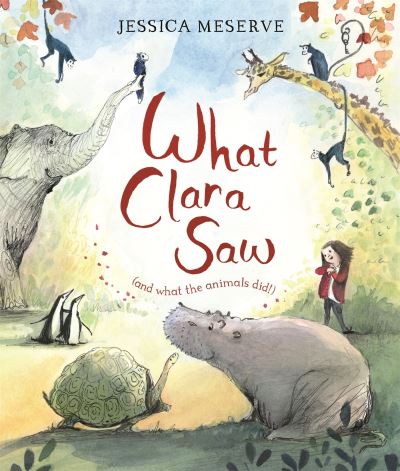
Title: What Clara Saw Author: Jessica Meserve Illustrator: Jessica Meserve Publisher: Macmillan Publication Date: 2019 ISBN: 978-1509866601
“Can a chimp chat, or a tortoise feel teary? Do animals help each other and do they feel love?”.
Emergent learning:
What is it about nature that is so wonderful?
It is the variety, the diversity, and the ecological wonder of our recognition of natural interdependence . Every plant, animal, fish, bird insect on the planet, humanity included are part of a diverse living community, and we rely on each other and we must learn to respect each other.
In the early years it is the child’s sensory experience of their interactions with the physical environment that dominates their learning. That is why it is important to ensure young children enjoy a wider range of physical stimulation, this is also why it is important to take them out into the natural environment, and why it is important for them to gain experience of different terrains and environments, to play in, and to play with. These include different media such sand and water . Many significant environmental features are so common in the child’s life that they will not be noticed, unless we draw their attention to them. This includes the natural wildlife which needs to be protected. In early childhood education, we often guide children to love animals and cherish life. While most children can understand this idea and express agreement in words, in daily life, when they actually encounter small creatures (e.g. a spider or a caterpillar), they may still act on curiosity or impulse and harm it. While it may often be assumed that it is enough for children to spend lots of time outside enjoying the natural environment, that really isn’t sufficient in itself if we want them to learn to have care and concern for the natural world. There are serious problems in our natural environment, and we should respect our children enough to avoid hiding these problems from them.
Animals are hurt needlessly, and even sometimes killed just for sport. Climate change is another problem that we have all contribute towards, and it will have a significant effect upon our children’s lives. These subjects are constantly addressed in the media and even the youngest children ask us questions about it. We want to prepare our children for the future but many of us worry that talking about our contradictory behaviours, and the environmental dangers, and the fate of endangered species will encouraging despair and anxiety.
The answer to this apparent dilemma is help them feel that they can make a difference and to celebrate our collective human efforts to mitigate the effects of climate change. This is what educators mean when they refer to early childhood education for sustainable citizenship, its all about encouraging children to recognise that they are not victims, they have agency and can make a difference.
For health and safety reasons we draw the child’s attention to the importance of hygiene in the early years, and the dangers of steep drops, deep water, and electricity. Parents and teachers also consider topics such as changes in the weather, and our responses in terms of gaining shelter and protective clothing of value. With the advent of global warming, the child’s future understand of the subject requires that they appreciate the heating effects of the sun, and the effects of obstructions to the sun provided by shade, and the ‘greenhouse’ capture of heat that is felt whenever we find ourselves in sunlight under glass.
Activity recommendation:
Being wary of new a new environmental encounter is a good survival instinct but one way we learn to respect differences is to recognise similarities. Charles Darwin is famous for his 1859 book The Evolution of Species... but he also wrote The Expression of the Emotions in Man and Animals in 1872 and a legacy of that in recent years has been a greater recognition of the embodied nature of many human emotional expressions. We are all animals. Unfortunately children often grow up to disrespect and/or fear many animals. In some cultural contexts children may also grow up to fear even very superficial differences between people, and they may even begin to adopt cultural prejudices. This isn’t sustainable. This is why many preschools around the world ensure that their play resources include small world people and dolls with different skin colours.
We live in a world where historical conflicts and competition have often encouraged the development of fear and prejudices. Yet diversity provides the underlying strength and resilience of every ecological system. This holds throughout nature, and is equally true of every social, cultural, and commercial organisation or nation state. Creativity requires a diversity of ideas and of experience. Prejudices are undermined when we recognise that the diversity to be found within every supposed human group is actually greater than the differences between them. This applies to the nations of the world, as well as to gender and different cultural and ethnic groups. In all of this it is especially important to recognise that skin colouration is a variation that is literally only ‘skin deep’ . Modern science has shown that the outdated ideas of their being separate biological ‘Races’ were simply wrong…
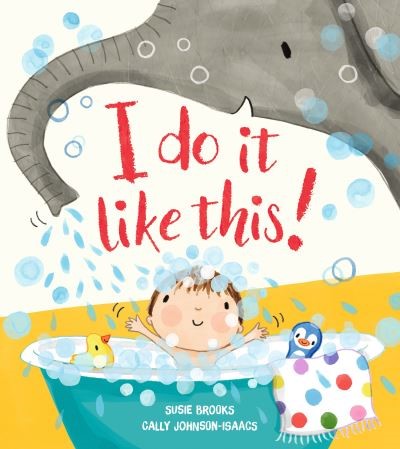
Title: I do it like this! Author: Susie Brooks Illustrator: Cally Johnson-Isaacs Publisher: Kane Miller Books Publication Date: 2019 ISBN: 978-1610678261
Key idea: Energy is required in everyday life – e.g. Learning about energy sources and the importance of reducing electricity consumption (UC5.4).
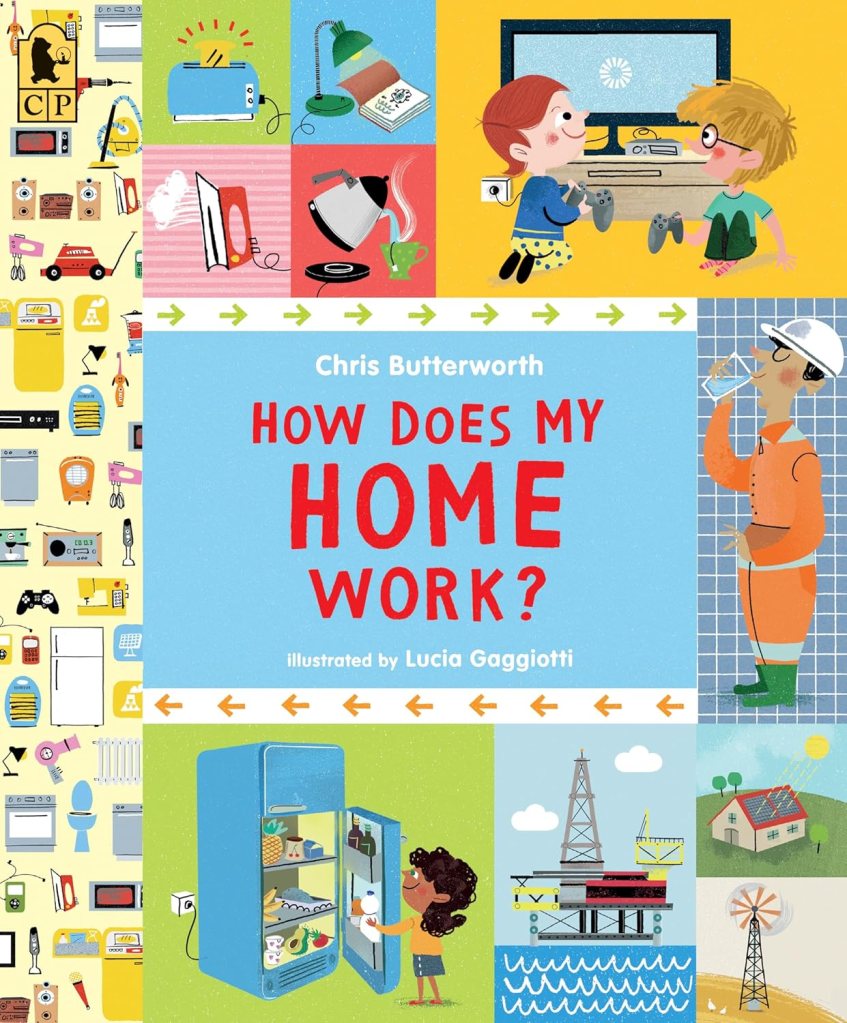
Title: How Does My Home Work Author: Chris Butterworth Illustrator: Lucia Gaggiotti Publisher: Candlewick Publication Date: 2020 ISBN: 978-1536215946
“Travel beyond the walls and under the floors of a house to find out more about the electricity, water, and natural gas that make your home work”.
Emergent learning:
Energy consumption and reduction is an important educational topic in the early years for both safety and for sustainability reasons. In the period of a single lifetime, around the world, the use of electricity and electronics has grown from a marginal interest to completely dominate many of our everyday lives. Yet it is sobering to recognize that about 8% (one in twelve or thirteen) of the worlds population still have no electricity at all in their homes. Electricity has traditionally been produced from fossil fuels like coal and oil, and it is only recently that we have started to invest in renewable alternatives. Electrical energy remains a finite resource, and in the interest of sustainability we mustn’t take it for granted. It really is shocking that so little attention is still paid to this subject in early childhood and primary education.
The most practical things we should encourage children to be aware of are the dangers: We can tell them that, just like water, electricity isn’t usually dangerous in small quantities. We don’t have to worry about a cup full of water, but we could drown in a bath, swimming pool, the sea or a lake. Electricity is similar, small batteries are usually safe but the electricity supplied by the cables in our household sockets can sometimes kill people. Rechargeable batteries can start fires and button batteries can be lethal if swallowed.
Burning Coal, Oil and Gas to create Electricity creates pollution, and global warming so it is important to switch lamps and devises off when they are not being used, to remember to close the refrigerator door, wear clothes more than once, and value alternative means of entertainment. We can also celebrate and encourage the introduction of alternative solar, wind and hydro electric sources with our children.
Activity recommendation:
Many suppliers provide Electrical Usage Monitors (there are large screen versions) and/or you can create a white board or paper chart showing your overall consumption – and you can set targets to reduce it. Always switch things off when they are not in use. Introduce a box of small battery’s in holders with the wires, lamps, buzzers, motors, wheels, and propellers for children to freely play with. The most practical and important thing that we should support children’s awareness of is the dangers of electricity – but just like water, electricity isn’t usually dangerous in small quantities. We don’t have to worry about a cup full of water, but we could drown in a bath, swimming pool, the sea or a lake. Electricity is similar, small batteries are usually safe but the electricity supplied by the cables in our household sockets sometimes kill people. The exceptions to this may be rechargeable battery’s that can start fires, and button batteries that can be lethal if swallowed.
Key idea: We all have a role to play – e.g. involving the children in awareness raising or practical campaigns in supporting environmental sustainability (UC4.4).
Key idea: Care for our environment will contribute to our individual and social wellbeing – e.g. Celebrating the sustainable actions of the preschool, local. National and international community (UC5.5).
Key idea: Children learn that they have AGENCY when they grow and make things, they learn that their efforts and choices have a tangible impact. In the process children gain a sense of belonging, self-efficacy, competence, resilience and responsibility, all crucially important in their development of a strong sense of identity and independence.
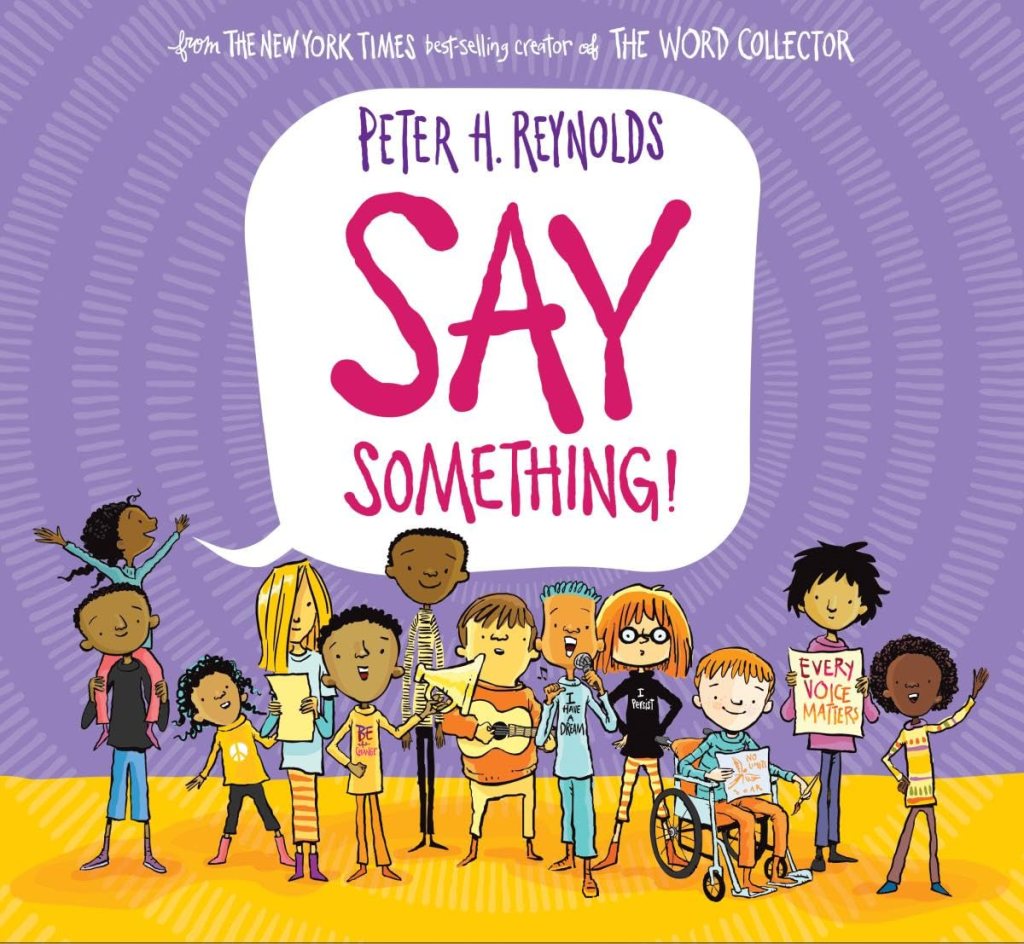
Title: SAY Something Author: Peter Reynolds Illustrator: Alison Jay Publisher: Orchard Books Publication Date: 2019 ISBN: 978-0545865036
A book that encourages children to find their own voice – through words, art, actions, or simple acts of kindness.
Emergent learning:
Climate Change Action requires international solidarity, co-operation and collaboration which in turn requires humility and mutual respect. No individual, and no nation, can achieve what is required to save the planet on their own, and yet we live in a world where historical conflicts and competition have often encouraged the development of prejudices and mistrust.
To some extent concerns about people we are less familiar with might be considered inevitable, from their very first weeks baby’s develop attachment to the familiar faces and sounds that they have heard from their parents and primary carers. These attachments are important, but in the absence of any experience of alternative skin colours and languages, prejudiced ideas may later come to be uncritically accepted. That is why most nurseries encourage children to play with dolls that have different skin colours. Picture story books showing the common concerns of people and children from around the world can also provide an important contribution, and in early childhood Language AwarenessEducation also has a major contribution to make.
Activity recommendation:
A recurring theme throughout all of these episodes has been the importance of involving the children in sustainable practices. If we are concerned to provide the foundations for our sustainable citizens of the future, we must encourage sustainable habitual actions, and habits of mind. Where we share sustainable activities with the children they benefit doubly, because they can see that the significant adult role models in their lives also consider them important.
Growing food, herbs and flowers for a purpose is a wonderfully sustainable, and fulfilling activity for children and colleagues to engage in and there are a wide range of different gardening activities that can be implemented in nurseries, schools and homes. Even more importantly the child will come to recognise their own agency, their ability to change and make the world a better more sustainable place which will have long lasting benefits when they come later to bring up children of their own.
As an educational subject, Design and Technology education also has a role to play. It involves children in designing, making and evaluating products out of resistant materials, adding value and creating food products, and considerations of conservation and nutrition.
Technology and its products are shaped by, but also serves to shape society, our behaviours, institutions and relationships. Education for citizenship must aim to develop technological awareness, so that our children grow up to be sensitive to the social and cultural implications of technology and their role as critical consumers and creators.
Bilingual Picture Story Books and Videos may be especially valuable in supporting children’s emergent language awareness. A familiar story heard initially in the child’s mother tongue will be recognised when presented in a different language. Children are often delighted to discover the cleverness of other languages.
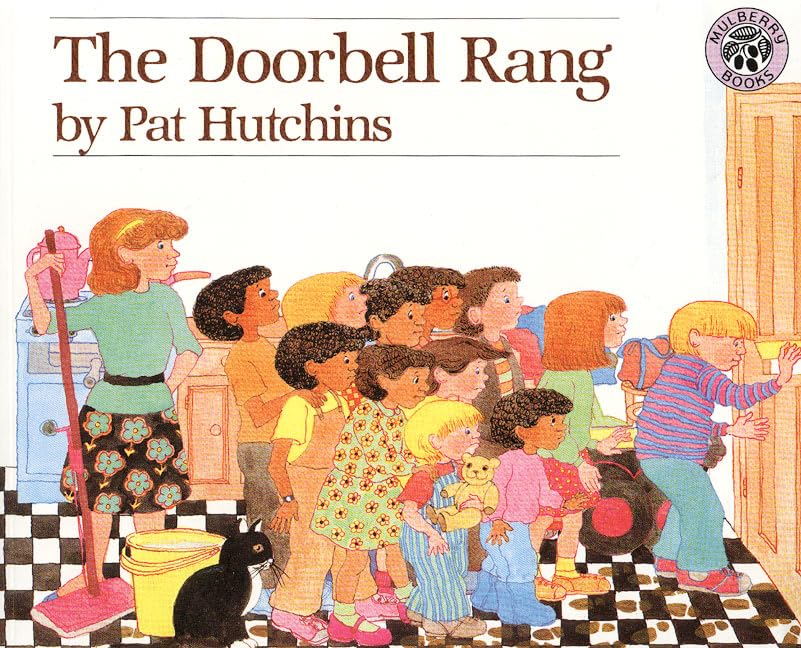
Title: The Doorbell Rang Author: Pat Hutchins Illustrator: Publisher: Greenwillow Publication Date: 2086 ISBN: 978-0688052522
A fun book about sharing and friendship that also supports emergent numeracy.
Emergent learning:
The economic benefits of sharing are obvious, and if we are no longer using something it costs us nothing to give it to someone who will use it. There are also many social and emotional learning benefits that can be gained through children sharing, they learn to build and maintain friendships, they develop patience and empathy, how to cooperate, and how to manage their emotions.
Preschools often organise toy and book sharing libraries and the best of these projects involve the children at every stage of their planning and execution. Extensions of this involve the sharing of outgrown school uniforms, children’s clothing, and car sharing in the transportation to and from the preschool. All of these things can operate at any level, between individual families or whole communities.
Activity recommendation:
When we are working with children in fund raising for good causes, as adults it is important for us to recognize that there can sometimes be a downside to giving simple charity: At its worse it can encourage false notions of superiority in the donors, and of dependence for recipients. One of the best ways to avoid that is to encourage exchange, to provide practical rather than financial support, or to provide groups or individuals with reduced interest or interest free loans that support their own efforts. This way we can empower individuals and groups to become more self reliant and sustainable. Examples include the development of mutual aid projects, community gardens, and micro-finance initiatives. The OMEP-UK Early Childhood Education for Sustainable Citizenship Award: A Call for Partnerships – John Siraj-Blatchford – OMEP Global Partnership Strategy for early c…od, 2021-2030 – UNESCO Digital Library
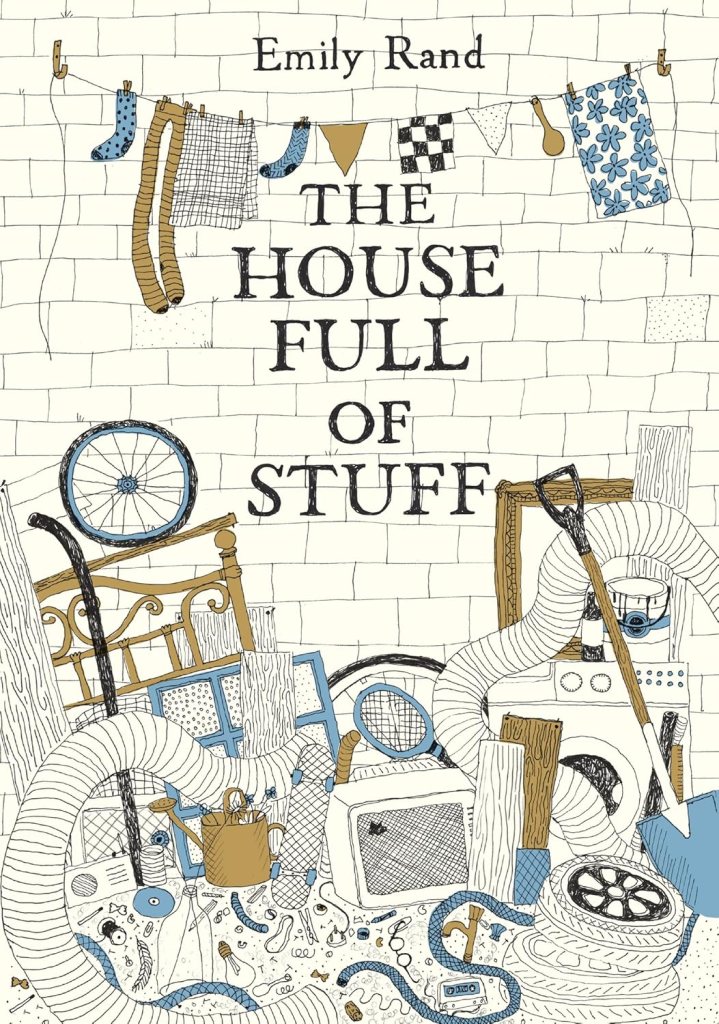
Title: The House Full of Stuff Author: Emily Rand Illustrator: Emily Rand Publisher: Tate Publishing Publication Date: 2019 ISBN: 978-1849766623
A boy befriends a neighbour who loves collecting useful junk that he uses to fix and mend things with.
Emergent learning:
Sustainable consumption requires the use and purchase of products and services that minimise the impact on the environment. As we make these decisions as adults we can share our successes and frustrations with our children so that they become critical sustainable consumers themselves in the future. To do this we need to share and review product information.
One of the things we are up against is ‘planned obsolescence’. As informed consumers we can exert our purchase power to discourage manufacturers building in early obsolescence, and we can campaign for more sustainable alternatives. Products are sometimes deliberately designed to have a limited lifespan to encourage us to make repeat purchases, but this can only increase a producers profits if we continue to buy the products. Examples include the design of products that make repairs difficult or impossible, the release of software updates that reduce the speed or functionality of older devices, and the ‘smart chips’ introduced into ink cartridges to prevent their use after a certain period or page count.
Activity recommendation:
In our preschools and at home we can share the task of making repairs – to our story books , toys and resources with the children, and we can draw their attention to the work of caretakers and other maintenance staff who care for our shared buildings, furnishings and fittings.
Popular TV series such as The Repair Shop have encouraged the development of a wide range of community repair ‘cafes’ networks and services where volunteers take pride in bringing things back to life. Community repair projects are increasingly creating welcoming spaces to bring people together, share skills and do something positive and practical together that feels really worthwhile and good! https://www.bbc.co.uk/programmes/b08l581p
Key idea: There are better ways to deal with things that you no longer need – e.g. Involve the children in Recycling, Upcycling, Reuse, Repair, Giving and Sharingactivities.
Key idea: Sustainable waste practices aim to keep materials in use for as long as possible – e.g. Teach children to reuse things instead of always trying to buy new items. Second-hand swop shops for books, coats, boots, toys. Donating outgrown clothes to others or to charities. (UC6.7)
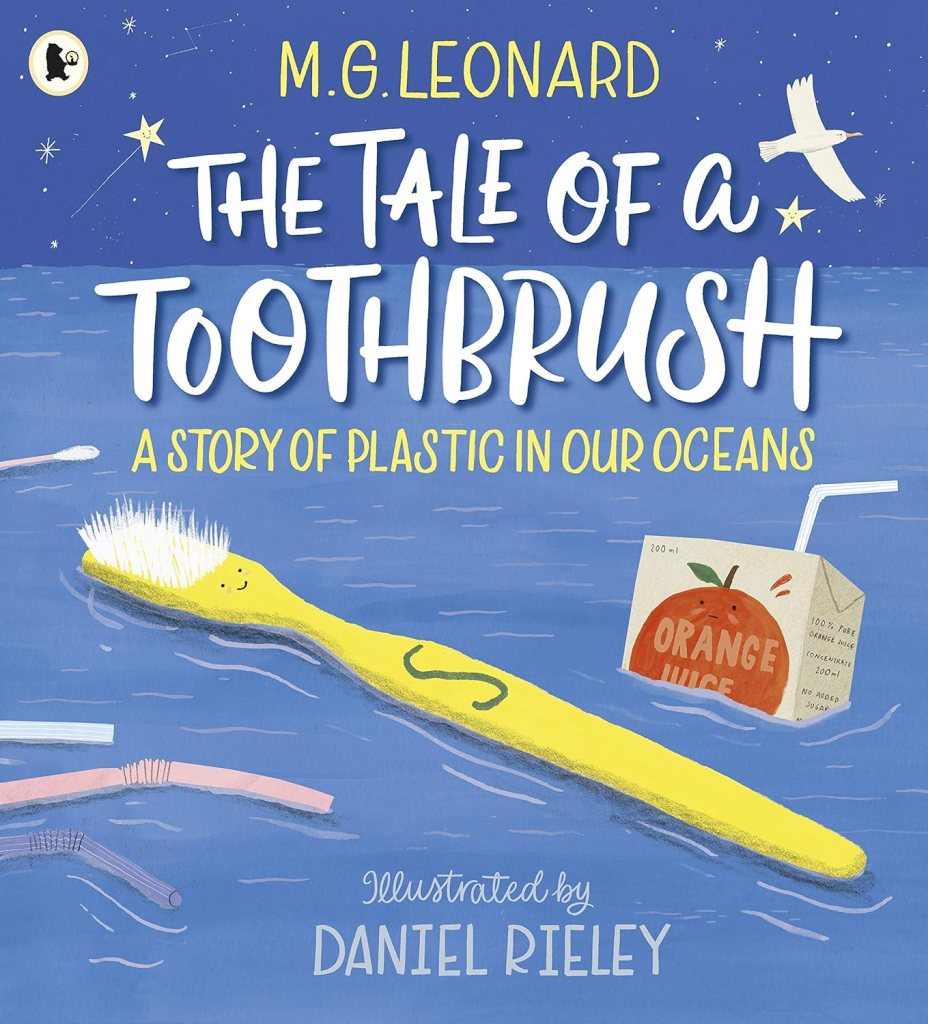
Title: The Tale of a Toothbrush: A Story of Plastic in our Oceans Author: M. Leonard Illustrator: Daniel Rieley Publisher: Walker Books Publication Date: 2020 ISBN: 978-1406391817
What happens to all our toothbrushes when they’re no longer needed? What can we do about it? What happens to other forms of Plastic Pollution?
Emergent learning:
When an item is ‘Reused’ it often doesn’t change its original form or use – as is the case of items that are upcycled or recycled. Reuse aims to extend an unwanted products life. Often this entails finding an alternative user for items such as scrap paper, packaging, furniture or clothing.
Disposal is the opposite of reuse, and children can learn to recognise, and even campaign against the use of disposable products such as gift wrappings, plastic cups and cutlery, paper towels and dishcloths. Many of the alternatives such as Furoshiki Wrapping Cloths, the use of your own chop sticks or multi-use drink containers are recognised as increasingly fashionable, and they make a personal statement of good taste and values.
Activity recommendation:
Children can be involved in reusing kitchen cans and jars for storage, cutting up old fabrics for cleaning, or using coffee grounds as fertilizer. Another valuable activity is to involve them in surveying your waste. Randomly emptying and sorting out the contents of your waste bin to see what might be reduced, reused, and recycled. An old toothbrush might, in the process, find a new life as a dolls hairbrush, for shoe cleaning or even as a paint brush.
Key idea: Taking climate action is urgent – e.g. Invite community leaders into the preschool to explain their climate actions. Create real or pretend sustainable bazaars, action plans, silent marches, etc
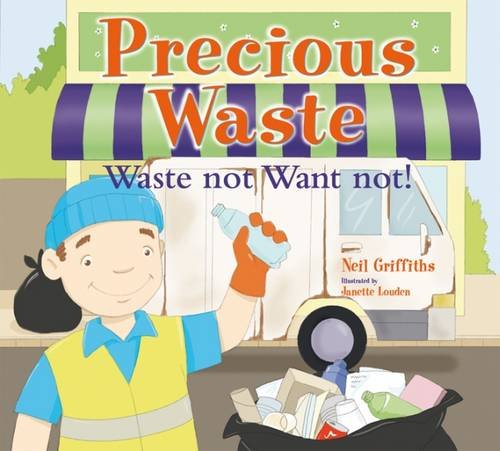
Title: Precious Waste Author: Neil Griffiths Illustrator: Annette Louden Publisher: Red Robin Books Publication Date: 2016 ISBN: 978-1904949152
“Refuse collector Ryan goes on a mission to change the mindset of the locals about recycling their rubbish and waste”.
Emergent learning:
Recycling is all about conserving the materials something is made from, so that it can be used to make something new.
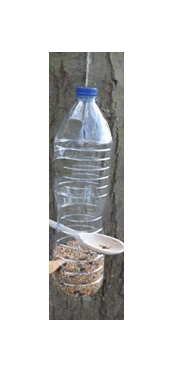
Upcycling is completely different from recycling. It is all about taking an item that would otherwise be waste and improving it in some way to make it useful again. A plastic bottle, for example, can be transformed into a face visor for a space suit, a plant pot, a watering can, or a bird feeder. Upcycling is highly creative, and the only limits are our imagination and our skills.
Recycling activities encourage economy and as they involve the children in sorting, this helps them develop their early number skills. They also learn about materials which is valuable in terms of early learning in science and design and technology.
Activity recommendation:
Upcyling activities support and encourage children’s creativity. A simple bird feeder may be improvised using a plastic bottle cut with feed holes and sticks positioned to provide a perch. Having introduced the basic idea children can be encouraged to observe their feeder in action and develop modifications for improvement. The choice of food itself is also a ‘food design and technology’ activity, and
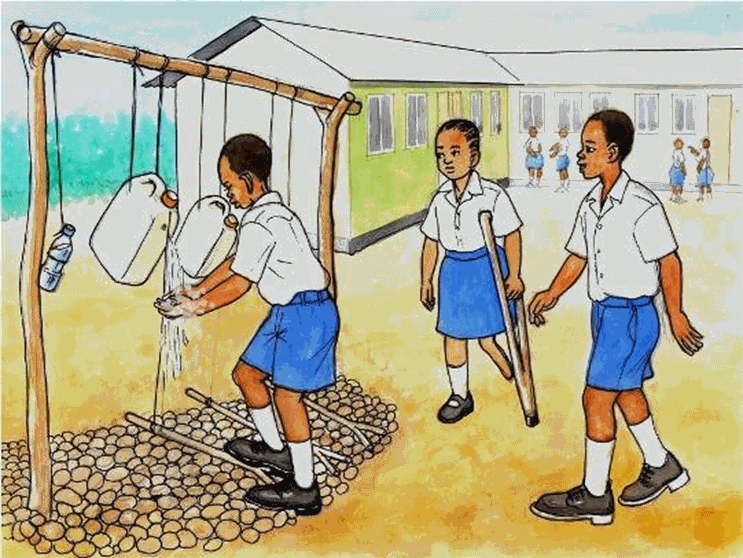
We often use Upcyling examples from the preschools of poor countries because they provide powerful illustrations of clever and creative innovations that children can learn to respect and admire. One popular example is the “Tippy Tap” often found in rural preschools in Africa where there is no piped running water for toilets and sanitation. To make your own, all you need is a plastic (e.g. milk/squash) bottle that you suspend with string from its handle, another string is tied between a stick on the ground and the spout so that when you put your foot on the ‘pedal’ it pours the water. You will see a picture on our web page and you will find it’s a good way of conserving water and providing hygiene in your garden and other outside play areas.







 Involve Me