- Key idea: Energy is required in everyday life – e.g. Learning about energy sources and the importance of reducing electricity consumption (UC5.4).
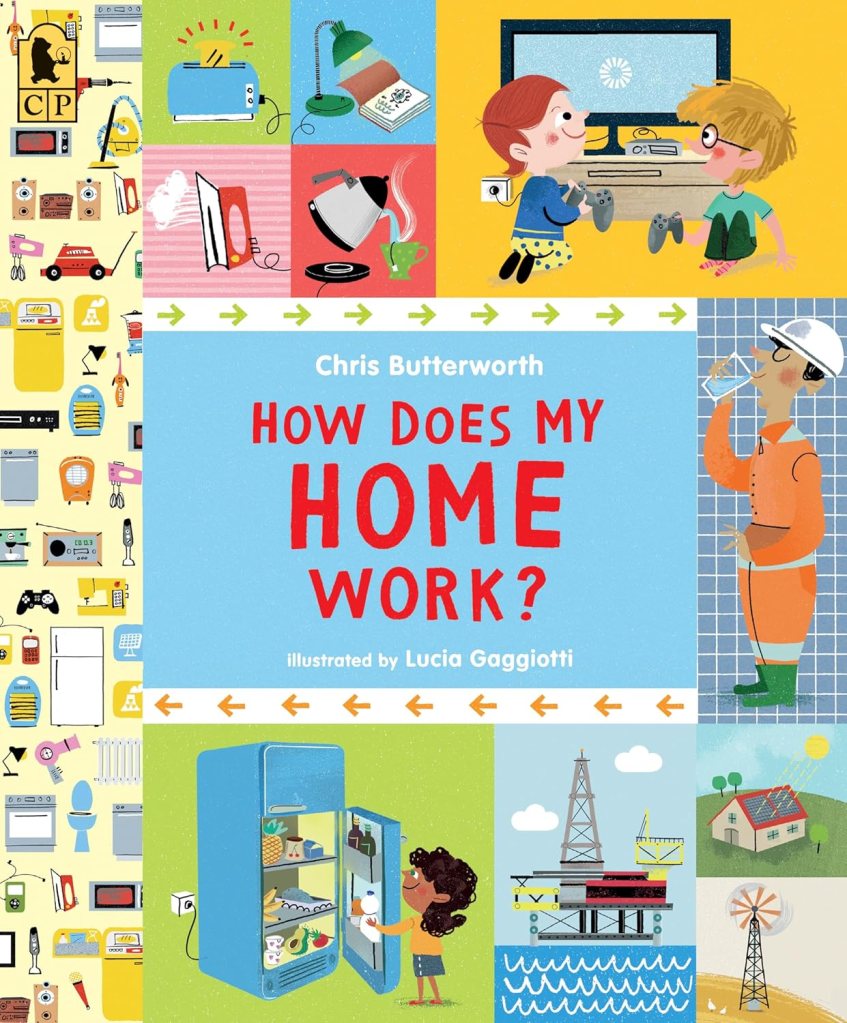
Title: How Does My Home Work
Author: Chris Butterworth
Illustrator: Lucia Gaggiotti
Publisher: Candlewick
Publication Date: 2020
ISBN: 978-1536215946
“Travel beyond the walls and under the floors of a house to find out more about the electricity, water, and natural gas that make your home work”.


Emergent learning:
Energy consumption and reduction is an important educational topic in the early years for both safety and for sustainability reasons. In the period of a single lifetime, around the world, the use of electricity and electronics has grown from a marginal interest to completely dominate many of our everyday lives. Yet it is sobering to recognize that about 8% (one in twelve or thirteen) of the worlds population still have no electricity at all in their homes. Electricity has traditionally been produced from fossil fuels like coal and oil, and it is only recently that we have started to invest in renewable alternatives. Electrical energy remains a finite resource, and in the interest of sustainability we mustn’t take it for granted. It really is shocking that so little attention is still paid to this subject in early childhood and primary education.
The most practical things we should encourage children to be aware of are the dangers: We can tell them that, just like water, electricity isn’t usually dangerous in small quantities. We don’t have to worry about a cup full of water, but we could drown in a bath, swimming pool, the sea or a lake. Electricity is similar, small batteries are usually safe but the electricity supplied by the cables in our household sockets can sometimes kill people. Rechargeable batteries can start fires and button batteries can be lethal if swallowed.
Burning Coal, Oil and Gas to create Electricity creates pollution, and global warming so it is important to switch lamps and devises off when they are not being used, to remember to close the refrigerator door, wear clothes more than once, and value alternative means of entertainment. We can also celebrate and encourage the introduction of alternative solar, wind and hydro electric sources with our children.
Activity recommendation:
Many suppliers provide Electrical Usage Monitors (there are large screen versions) and/or you can create a white board or paper chart showing your overall consumption – and you can set targets to reduce it. Always switch things off when they are not in use. Introduce a box of small battery’s in holders with the wires, lamps, buzzers, motors, wheels, and propellers for children to freely play with. The most practical and important thing that we should support children’s awareness of is the dangers of electricity – but just like water, electricity isn’t usually dangerous in small quantities. We don’t have to worry about a cup full of water, but we could drown in a bath, swimming pool, the sea or a lake. Electricity is similar, small batteries are usually safe but the electricity supplied by the cables in our household sockets sometimes kill people. The exceptions to this may be rechargeable battery’s that can start fires, and button batteries that can be lethal if swallowed.
Electrical safety advice for children:
https://electriciancourses4u.co.uk/useful-resources/childrens-electrical-safety/
https://www.gov.uk/government/news/new-posters-promoting-button-battery-safety
Electronic technology is ubiquitous and even the youngest children can begin learning about electricity:
https://www.ase.org.uk/system/files/Yewman.pdf
Other Book recommendations:
Recommendation reason:

 Involve Me